
"TKDN Only Matters for Government Contracts." That Myth Is Costing Foreign Brands Market Share.
Most manufacturers I talk to don't actually say "TKDN." They say "made in Indonesia," as a point of pride, a marketing line, sometimes just a shorthand for "we've got local content covered."
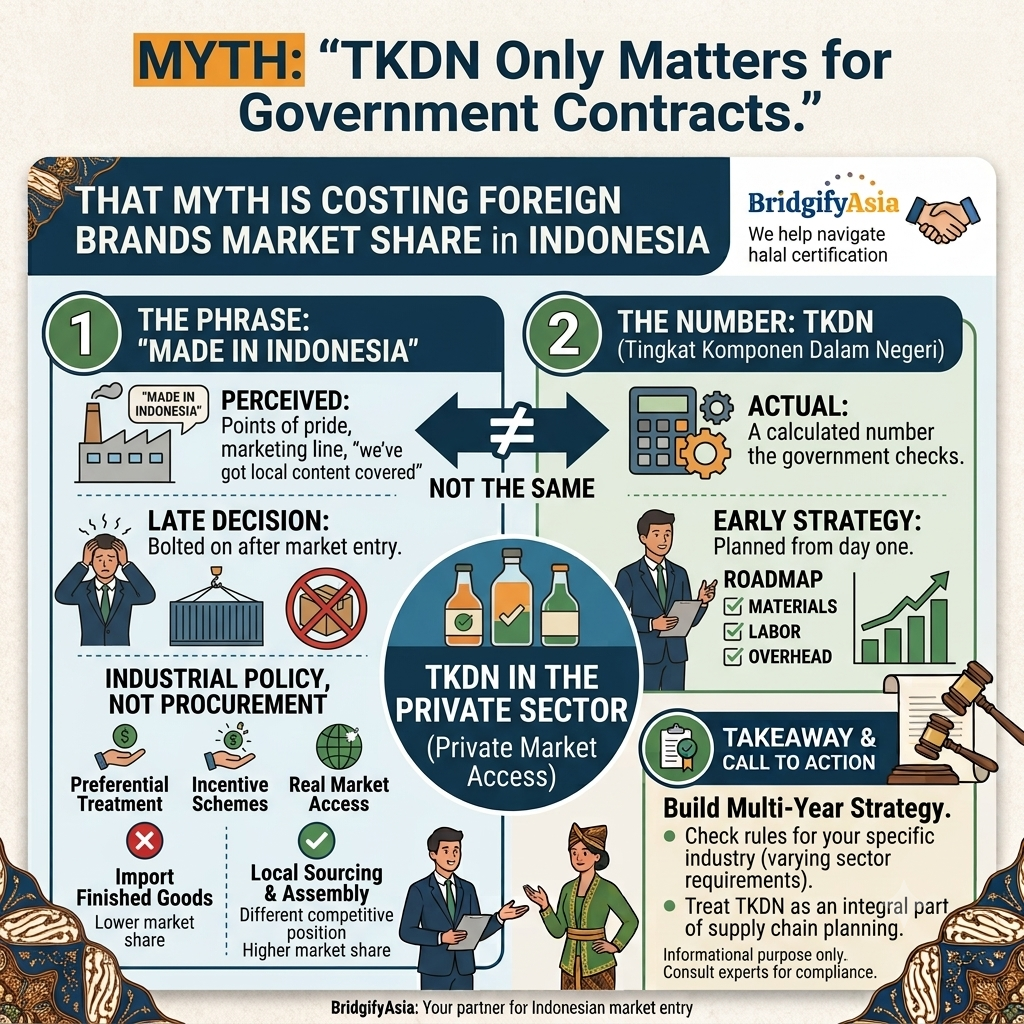
Most manufacturers I talk to don't actually say "TKDN." They say "made in Indonesia," as a point of pride, a marketing line, sometimes just a shorthand for "we've got local content covered." The problem is that "made in Indonesia" is a phrase, and TKDN is a number the government actually calculates and checks. Treating the phrase as if it settles the number is exactly where foreign brands lose ground without realizing it.
TKDN, Tingkat Komponen Dalam Negeri, Indonesia's local content requirement, is what "made in Indonesia" actually gets measured against once it matters legally, and it gets dismissed by a lot of foreign manufacturers as a government procurement issue only. "We don't sell to the Indonesian government, so it doesn't apply to us."
That's an increasingly outdated assumption.
TKDN requirements and incentives now touch private sector market access too, particularly in sectors where the Indonesian government is actively pushing local manufacturing and component sourcing as industrial policy, not just as a procurement rule. Products with higher TKDN scores can access preferential treatment, incentive schemes, and in some sectors, real market access advantages that pure import competitors don't get.
For foreign manufacturers, this creates a genuine strategic fork. Import finished goods and compete without TKDN advantages, or structure some level of local content, assembly, or sourcing to unlock a different competitive position in the market.
This isn't a decision to make late in a market entry plan. TKDN strategy affects supply chain and manufacturing decisions made years before a product hits an Indonesian shelf, not something bolted on after you're already selling.
If you're building a multi-year Indonesia strategy and TKDN isn't part of that conversation yet, it should be. TKDN rules vary a lot by sector, so treat this as a prompt to check your specific industry rather than a blanket rule.
If you're weighing this trade-off for your own product line, that's a strategic conversation worth having early. Happy to compare notes. And for anyone who's had a deal or bid affected by TKDN outside a straight government contract: what happened?
Ready to Take Action?
Speak with our specialists about your specific regulatory requirements.
Book a Free Consultation